
Painting Tāmaki Makaurau green: the community gardens redefining third spaces
By Niamh Raynes – Te Waha Nui
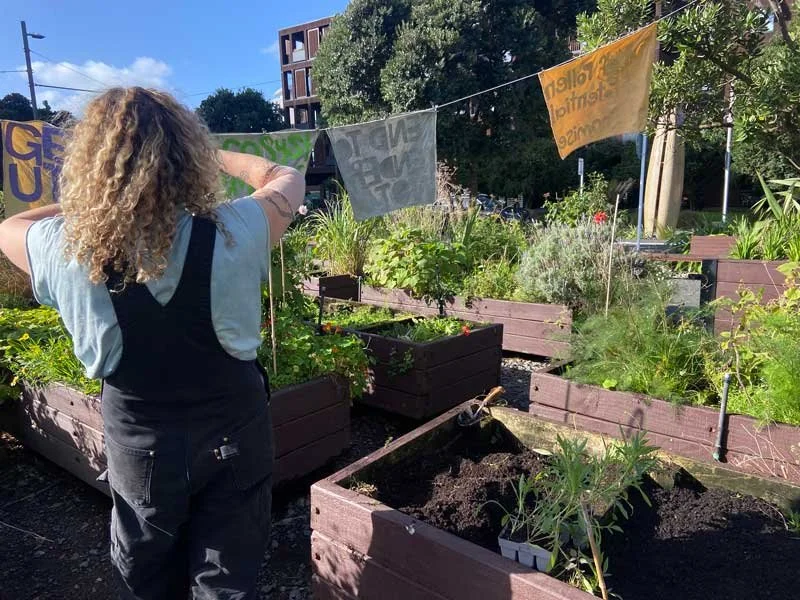
Every new year, almost everyone commits to picking up a new hobby or getting out and meeting new people. But achieving these goals in the city is easier said than done. Options can often be limited to pricy workshops, and for someone trying their hand at something for the first time, the added costs can detract from what should be an enjoyable experience.
Additionally, meeting people can prove surprisingly hard in a bustling metropolis. For most of us, the usual advice for meeting new people is to ‘put yourself out there!’ But often the pressure to go from casual acquaintances to fast friends just adds an extra layer of anxiety to proceedings.
New year's resolutions or not, what most city dwellers want are more opportunities to connect with the communities in their area.
Central City community gardens provide much-needed third spaces for inner-city residents and a chance to take a break from the hustle and bustle of metropolitan life. From Wynyard Quarter to the University of Auckland’s Law School, Tāmaki Makaurau plays host to a sprawling map of community gardens.
Waitematā Local Board Chairperson, Alexandra Bonham, says community gardens allow city locals from different backgrounds to connect with each other over a shared interest. “What's so lovely is that it brings all these different groups together to do something that is just entirely positive, where we're all on a journey together, trying to make our plants grow.”
The accessibility of community gardens also means organically meeting and befriending new people without added anxiety. “You have these really, good conversations, but also you can have a massive tract of silence and you're both weeding or doing your thing. And that is also absolutely fine. It's so low pressure,” Bonham says.
Daldy Street community garden coordinator Antony Phillips says that, in the most densely populated residential area in the country, community gardens are an important social service for connecting individuals with their wider city community. “When you have those spaces, then there are opportunities for community building and strengthening community networks and neighbourhoods.” However, operating amongst the bustle of city life is not without challenges.
Central city community gardens are accessible to the public, which unfortunately also means these spaces are vulnerable to vandalism and littering, as is already common across Tāmaki Makaurau.
City Centre Garden Network Coordinator, Dorestie Liew, says that this often results in extra pressure being placed on upkeep. “When spaces start to look a bit neglected, people treat them like neglected spaces.” While a solution to this problem may be limiting public access to community gardens, this could also potentially limit the social benefits these spaces provide.
When discussions of third spaces and community building arise, the conversation often leads to the question of the cost of community.
Liew says that while community gardens are a space for inner-city residents to exist without the obligations that dictate day-to-day life, there should still be a shared obligation amongst those who enjoy the community gardens to share the work of maintaining the spaces.
“I think it's nice to be an active participant in the world and put nice things in, clean up rubbish, and have that shift, that attitude, and then hopefully there's a bit of a cultural change that needs to happen where people think it's no longer okay to just go in and vandalize, you know?”
Shared with generous permission by Niamh Raynes – Te Waha Nui